

Great store. Will be my favorite in the future. Sent quickly. All items are brand new sealed. And the prices are very nice. Separately, I want to thank Álex Guerra, who controlled my order from start to finish. In general, you are great!!
Thank you for the service. Absolutely top
Great comms. Very helpful and reliable all along
Order placed packaged well, dispatch and delivered promptly Would use again. Thank you
42/5000 the best team, both human and technical
-
Cómo elegir una antena TDT según la señal, la vivienda y la instalaciónElegir una antena TDT parece sencillo hasta que aparece la pregunta importante: ¿qué antena necesito de verdad para que la señal se vea bien y no me obligue a hacer pruebas sin fin? La respuesta no [...]
-
Antena Ellipse de Televes: qué ofrece y cuándo conviene esta solución TDTLa antena Ellipse de Televes lleva tiempo ocupando un lugar propio dentro del mercado TDT porque no se percibe como una antena terrestre más, sino como una solución pensada para quien busca una instalación exterior seria, [...]
-
Dinova o Campnova de Televes: qué antena conviene según la instalación y el uso
Cuando alguien compara Dinova y Campnova de Televes, normalmente no está dudando entre dos antenas cualquiera. Está intentando decidir entre dos soluciones que comparten marca y cierto enfoque de captación terrestre, pero que no responden exactamente [...]
-
Cómo mejorar la recepción TDT en casa paso a pasoHay instalaciones en las que la televisión sí se ve, pero no se ve bien del todo. Algunos canales se pixelan, la señal aguanta durante días y luego falla, en una habitación va peor que en [...]
-
No puedo ver la TV: qué comprobar paso a paso antes de tocar la antenaCuando un televisor deja de mostrar los canales o aparece el mensaje de “sin señal”, la reacción más habitual es pensar directamente en la antena. Sin embargo, en muchas ocasiones el problema está antes: en la [...]
-
Antena TDT activa o pasiva: qué diferencias hay y cuál conviene según la instalaciónCuando alguien busca una antena TDT, una de las dudas más habituales es si conviene elegir una antena activa o una pasiva. Sobre el papel parece una decisión simple, pero en la práctica influye mucho más [...]
-
Qué material necesitas para instalar una antena parabólicaMontar una antena parabólica no empieza realmente cuando subes a orientarla, sino cuando tienes claro qué material necesitas y qué papel cumple cada elemento dentro de la instalación. Muchas veces el problema no es instalar mal, [...]
-
Antena TDT de interior: ventajas, inconvenientes y cuándo merece la penaLas antenas TDT de interior siguen siendo una opción muy buscada porque prometen una instalación rápida, sin obras y sin intervenir en fachada o cubierta. En algunos casos cumplen bien su función, pero en otros generan [...]
What Is a Satellite Dish and How Does It Work?
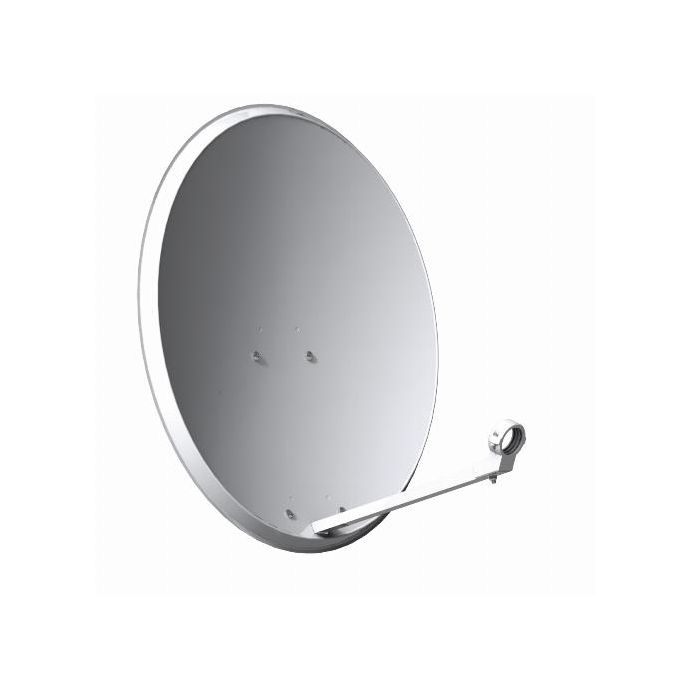
A satellite dish is a reflector antenna designed to receive signals from satellites orbiting the Earth. The dish focuses the signal on an LNB (low-noise block downconverter), which sends the content to your satellite receiver.
Improve Your TV Signal with High-Performance Satellite Dishes
Satellite dishes provide a more stable and powerful signal compared to terrestrial antennas, especially ideal for remote areas with weak TV reception or for accessing international content in high definition.
Premium Satellite Dish Brands We Offer
We stock top brands such as Televes, Engel Axil, Skyware, Cahors, EKSELANS, Daxis, and Famaval, ensuring high durability, strong signal reception, and compatibility with most satellite systems.
How to Choose the Right Satellite Dish Size
Dish sizes typically range from 60 cm to 120 cm. Smaller dishes are perfect for urban or standard signal areas, while larger dishes are better suited for rural areas or weak signal zones.
Satellite Dishes with LNB Included and Power Options
Many of our models include universal LNBs and support power via satellite receivers or external power sources, making installation simple and reducing extra cabling.
How to Install Your Satellite Dish Like a Pro
To achieve the best performance, install your dish on a stable surface facing the satellite, and use high-quality coaxial cables. Use a satellite signal meter to fine-tune azimuth and elevation for perfect reception.
Satellite Dishes for Community and Shared Installations
We offer large-diameter dishes and multiswitch-compatible systems ideal for shared buildings, apartments, or mobile setups like motorhomes, delivering HD and 4K signals to multiple units.
When to Choose a Satellite Dish Over a Terrestrial Antenna
Use a satellite dish when terrestrial signals are poor or unavailable. It’s also ideal for accessing international channels, multilingual broadcasts, and premium networks not available via TDT.
Durable, Weatherproof, and Vandal-Resistant Dish Options
Our dishes are built to withstand rain, wind, and extreme conditions, making them perfect for high-altitude areas, exposed roofs, or outdoor environments.
4K-Ready Satellite Dishes: The Ultimate Visual Experience
Enjoy ultra-high definition channels with our 4K-compatible satellite dishes, perfect for use with modern satellite receivers and Smart TVs. Get crisp, clear images and reliable signal at all times.
Dish Antennas for Satellite Reception
Satellite dish antennas are the most widely used antennas for receiving satellite signals. This type of satellite antennas are really a reflector where the signal bounces and enters through the LNB.
To buy a satellite dish, we must know which satellite television channels we want to receive and in what orbital position is the satellite to which the satellite dish should point. Once the satellite that sends the signal is known, we must choose the appropriate size of the satellite dish in our online store, since not all satellites send the signal with the same power. The larger the satellite dishes, the weaker we can pick up satellite signals.
What satellite dish should I install?
Without a doubt, the most important characteristic to take into account when buying and installing a satellite television antenna is the gain, regardless of whether or not it is parabolic. How much higher gain the parabolic antennas have, we can capture satellite television signals that arrive with less power.
It will also be important to combine a parabolic antenna with a suitable gain and size, together with an LNB with the necessary gain, since the LNB must be of quality so that the operation of the set is correct.
If we look around us a little, we can see how satellite dishes of different sizes are installed in the same building and oriented to different places. This is due to the fact that there are a large number of satellites located in a geostationary position (35,786 km above sea level) emitting satellite signals. In addition, each communications satellite emits different signals, either television or data links.
What satellite dish to buy?
Therefore, before buying a satellite dish, we must know a priori, which satellite we should point to. For example, if we want to watch the Andalucía Televisión channel (Canal Sur's satellite broadcast) we would have to point our antenna to the Astra 1KR satellite, located in the orbital position 19.2 degrees East.
What signal strength reaches our satellite dish?
Once we know by which satellites the signal we want to see is received, we have to check the coverage footprint of the satellite, to check that sufficient signal coverage reaches our location, and therefore choose the appropriate size for our satellite dish.
The satellite coverage footprint is a map, which tells us in which areas of the world the satellite broadcasts and with what power (EIRP). To consult these maps, we recommend using the official web pages of the satellite operators, as they are usually up-to-date. We can also use web pages that group all the satellite broadcast information worldwide, such as kingofsat or lynsat.
We return to our example. We want to receive Andalucía Televisión in the city of Barcelona, therefore if we access the coverage footprint of the Astra 1KR satellite we verify that it has coverage in this city, in the case of Astra we receive an EIRP greater than 51 dB. Be careful, we always talk about powers with higher values, since we have to look at the outside line.
Astra1KR coverage:

Although we will discuss it in the next section, I anticipate that the higher the EIRP, the satellite antennas will be smaller and therefore they will cost us cheaper both the purchase and the installation.
How to calculate the gain of parabolic antennas as a function of the EIRP?
We go to the next step to find out which dish we have to mount. Once we choose which satellite we should point our satellite dish to, we must know what gain the satellite dish should have, and therefore what size.
To know the gain we need, we again have to take into account the power received at the location where the satellite antenna is to be installed. We use the satellite footprint again and consult the EIRP again. It is always advisable to be a bit pessimistic and use an EIRP lower than that indicated by the coverage map. For example, if our location is close to the line that separates one EIRP level from another, it is better to choose the lower EIRP.
This precaution is due to the fact that if we choose an antenna with a very fair gain, the signal can be lost or pixelated, if we do not make a perfect installation. In addition, the received satellite signal can also be affected by adverse weather conditions such as wind, rain, hail or snow.
To know what gain we need in the parabolic antennas we have to use the following formula:
G = n * (Pi * D / L) 2
Where G = power gain (not in dB), n = overall efficiency, D = dish diameter, and L = free space wavelength.
Of course, we are not going to make calculations every time we have to install or buy a satellite dish, since these are very complex and many variables must be taken into account. Therefore, to avoid making calculations, tables are usually used, where the typical gain of a parabolic antenna is associated as a function of its size and the EIRP received for the KU band, which is the one that most satellite television signals are received.
|
EIRP (dBW) |
GAIN (dB) (12,75 GHz) |
Antenna Diameter (cm) |
|
52 51 |
35 |
50 |
|
55 |
||
|
50 |
36 |
60 |
|
48 |
37 |
65 |
|
46 |
38 |
80 |
|
45 |
39 |
90 |
|
43 |
40 |
100 |
|
42 |
41 |
110 |
|
41 40 |
42 |
120 |
|
39 |
43 |
135 |
|
38 |
44 |
150 |
|
37 |
45 |
180 |
|
36 |
47 |
240 |
Be careful, each antenna of the same size can have different gain levels depending on its surface, material used in the manufacture, painting, position of the LNB support, etc.
Despite the fact that the table is quite reliable, once the gain is known, we only have to go to the technical characteristics provided by the manufacturer and check that the antenna we need has a higher gain than the calculated one.
How do satellite dishes work?
As we mentioned in the introduction, a satellite dish is really a parabolic reflector. That is, a satellite dish is a piece of metal in the shape of a paraboloid, where the satellite electromagnetic waves bounce and are concentrated at a point, called a focus.
It is really at that point where the true "satellite antenna" is installed, which is really the device that we know as LNB (Low Noise Block). This LNB is responsible for adapting the electromagnetic signal received over the air, to an ideal frequency to transmit the satellite signal through the coaxial cable.
There are different types of LNBs depending on the frequency by which the satellite television signal is received. In television there are 2 types of working bands, the Ku band and the C band. In the case of parabolic antennas, there are no different types of antennas depending on the working band, although it will be necessary to use a different type of support. for LNBs, since C-band LNBs are wider than Ku-band LNBs.
Satellite dish antennas parameters and characteristics
As mentioned in previous sections, the most important parameter to take into account is the gain of the parabolic antenna. It is really the only technical characteristic to take into account, since the size of the antenna depends on the gain.
In addition to the gain, when installing a satellite dish, it is also necessary to take into account some characteristics. They are as follows:
- Dish material. Steel, aluminum and fiberglass discs are commonly found on the market. Keep in mind that steel discs tend to rust, while aluminum and fiberglass discs do not. If the antenna is installed in humid areas or near the coast, it is always advisable to install aluminum or fiber discs.
- Surface treatment. The corrosion of the discs with Epoxy-Polyester paint, fiberglass or polyester powder paint is usually avoided.
- Type of focus. There are 2 types, Offset and Prime Focus. The difference between an Offset antenna and a Prime Focus is the location of the LNB. The Offset antenna prevents the LNB itself from excess to the antenna, while the Prime Focus antenna does shade and therefore reduces efficiency. On the other hand, Prime Focus antennas have more gain, since they have more surface area, and are used to build large antennas.
Tips for orienting a satellite dish
Finally we have to emphasize that the orientation of a parabolic antenna is much more complex than the orientation of a DTT antenna, which in many cases can be done by "eye".
The installation of a satellite dish antenna must be very precise, since they are highly directive antennas, and the deviation of a couple of millimeters can make us not receive anything. We recommend you read this article on our blog where we explain how to orient the satellite dishes.