





Great store. Will be my favorite in the future. Sent quickly. All items are brand new sealed. And the prices are very nice. Separately, I want to thank Álex Guerra, who controlled my order from start to finish. In general, you are great!!
Thank you for the service. Absolutely top
Great comms. Very helpful and reliable all along
Order placed packaged well, dispatch and delivered promptly Would use again. Thank you
42/5000 the best team, both human and technical
No se encontraron posts recientes.
Satellite Signal Amplification
This section is dedicated to the amplification of the signal that we receive from our satellite antenna (950-2400 MHz), since it will provide the necessary output signal level for its subsequent distribution. Depending on their location, we can find them in head end systems, mast amplifiers, IF line amplifiers, home interior amplifiers, broadband and programmable IF amplifiers.
SAT Amplifiers for Single Family Homes:
The usual thing in an installation where we have a satellite dish connected directly to a satellite receiver and that due to its long route we have little signal is to insert a simple line amplifier in the cable route, which only amplifies the satellite signal and feeds on its own satellite receiver.
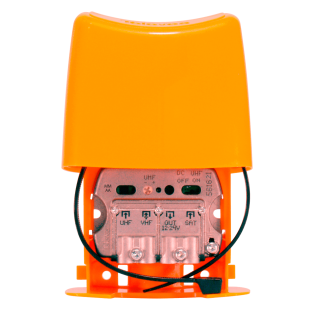
Mast amplifiers can also be used for single-family homes, which amplify the terrestrial signal and also mix it with the satellite to have both on the same cable.
Indoor home amplifiers work the same way as mast amplifiers, just mix satellite. They differ in that the interiors integrate the power supply and must be installed in the home's junction boxes, protected from the elements.
SAT Amplifiers for Collective Installation:
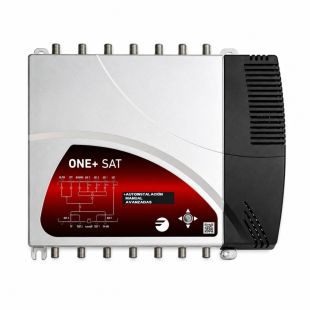
In the first place we find the broadband amplifiers with satellite, which have inputs for terrestrial and satellite. It also amplifies satellite, offering high output levels to distribute to a maximum of 30 outlets. While amplifying, it mixes with terrestrial to distribute both through the same cable. It is the most economical option for small neighborhood communities.
The programmable amplifiers offer many adjustment possibilities to achieve a flat response in the entire frequency band (terrestrial and satellite), guaranteeing correct reception of all channels. Likewise, by regulation, it is only valid for small groups, with a maximum of 30 outlets.
Monochannels are used for medium and large collective installations. Unlike terrestrial monochannels, where one amplifier is required per channel, for satellite signal only one single channel is used.
In distributions where, due to long distances, the amplified signal from the headend is not enough to reach all users, a multiband line amplifier must be added. They are equipment that is installed in the backbone of the facility to reamplify the TV and Satellite signal to the most distant users. These line amplifiers normally have 2 inputs and 2 outputs, since by ICT regulations there must be two cable downspouts, corresponding to TV+SAT1 and TV+SAT2. It is also possible to use 2 line amplifiers with 1 input and 1 output each.