





Great store. Will be my favorite in the future. Sent quickly. All items are brand new sealed. And the prices are very nice. Separately, I want to thank Álex Guerra, who controlled my order from start to finish. In general, you are great!!
Thank you for the service. Absolutely top
Great comms. Very helpful and reliable all along
Order placed packaged well, dispatch and delivered promptly Would use again. Thank you
42/5000 the best team, both human and technical
-
 Cómo detectar y cambiar un latiguillo de fibra óptica: caso práctico
Aprende a localizar un fallo en un latiguillo de fibra óptica, qué revisar antes de sustituirlo, cómo elegir el recambio y cómo comprobar que la instalación vuelve a funcionar.
-
 Cómo instalar una antena Dinova en una caravana o autocaravana paso a paso
Aprende a instalar una antena TDT Dinova en una caravana o autocaravana: material, soporte, alimentación, orientación, comprobaciones y errores frecuentes.
-
 Comelit Ultra: qué ofrece esta gama de videoporteros y cuándo elegirla
Descubre qué ofrece Comelit Ultra, qué módulos existen, en qué se diferencia de una solución básica y cuándo tiene sentido para una vivienda, comunidad o edificio.
-
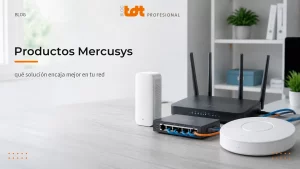 Mercusys: qué es, si es buena marca y qué solución WiFi elegir
Mercusys es una marca especializada en equipos de conectividad para hogares y pequeñas oficinas. Su catálogo incluye routers WiFi, repetidores, sistemas WiFi Mesh Halo, dispositivos 4G y 5G, adaptadores, soluciones Powerline y switches. La marca suele [...]
-
 Cómo conseguir mejor cobertura WiFi según tu casa, negocio o instalación
La mala cobertura WiFi no siempre significa lo mismo. En una vivienda puede aparecer en una habitación lejana, en una planta superior o en una zona con muchos obstáculos. En un negocio o una pequeña oficina, [...]
-
 Cómo configurar un TP-Link TL-WA854RE con el ordenador y sin WPS
Cuando un router no tiene botón WPS o la vinculación automática no funciona, todavía es posible configurar un repetidor WiFi desde el ordenador. Ese es precisamente el caso de muchos usuarios que buscan cómo poner en [...]
-
 Cómo instalar un repetidor WiFi paso a paso y qué comprobar después
Instalar un repetidor WiFi parece una tarea sencilla, pero buena parte de los problemas no aparecen en el momento de enchufarlo, sino después: cuando la cobertura apenas mejora, cuando el equipo se conecta pero la navegación [...]
-
 Guía de compra profesional: EAP615-WALL, EAP610EXT y EAP613
EAP615-WALL, EAP610EXT y EAP613: qué punto de acceso elegir según la instalación Cuando una instalación ya pide un punto de acceso más serio, la siguiente duda no suele ser si hace falta un equipo profesional, sino [...]
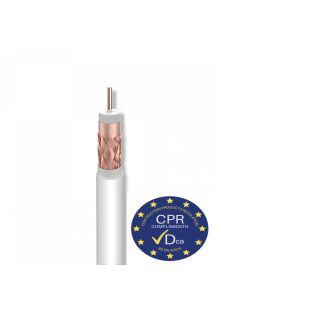
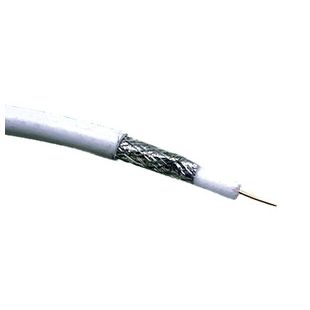
RG6 Coaxial Cable: The Basis for a Stable, Quality TV Signal
RG6 coaxial cable is an essential component in any installation of digital terrestrial television (DTT), satellite television (TVSAT) or CCTV video surveillance systems. Its ability to transmit signals with minimal loss and high protection against interference makes it the preferred choice of industry professionals.
In our online shop you will find a wide variety of RG6 coaxial cables, with different configurations of materials, shielding and lengths, to cover any need in residential, commercial or industrial projects.
Looking for a quality cable for your TV or CCTV installation?
Discover our Class A and Cu/Cu shielded options to ensure a clear and stable signal.
Advantages of our RG6 Coaxial Cables
Stable and interference-free transmission
The cables are designed to guarantee a constant signal, even over long distances.
Compatibility with DTT, SAT and CCTV
Suitable for connections of:
- Digital Terrestrial Television (DTT)
- Satellite dishes (SAT)
- Video surveillance systems (CCTV)
High quality materials
- Cu/Cu (copper-copper): Maximum conductivity and resistance.
- Al/Cu (copper-plated aluminium): Economical and reliable option.
- Ac/Cu (copper-plated steel): For specific installations.
Class A, A+ and LTE shielding
Protection against interference from 4G and 5G signals.
Variety of external coatings
- PE (Polyethylene): Outdoor use.
- PVC (Polyvinyl Chloride): Indoor installations.
- LSZH (Halogen Free): Increased safety in case of fire.
Available in different formats
25m, 100 m, 250 m, 500 m reels.
Compliance with ICT2 regulations
Approved for use in installations regulated by Spanish Common Telecommunications Infrastructure (ICT) regulations.
All types of RG6 coaxial cable are available

| Acronyms | Covering material | Acronyms | Covering material |
| PE | Polyethylene | Cu | Copper |
| PEE | Polyethylene Expanso | Ac+Cu | Copper-plated steel |
| PVC | Polyvinyl chloride | Al+Cu | Copper-plated aluminium |
| LSFH | Halogen free | CuSn | Tinned copper |
| LSZH | =LSFH | Al | Aluminium |
How to Install a Coaxial Cable Correctly?
1. Plan the route:
Avoid running the cable near electromagnetic sources.
2. Cutting and stripping:
Use suitable tools to strip the cable without damaging the conductor.
3. Connecting the connector:
Choose a compatible connector (F, BNC or RCA) according to the application.
Fit the shield correctly to ensure shielding.
4. Signal testing:
Check the signal level and the absence of interference.
Frequently Asked Questions (FAQ)
1. What is the difference between RG6 and RG59 cable?
RG6 has a thicker inner conductor, which allows transmissions over longer distances without significant loss.
RG59 is used more in CCTV video surveillance.
2. What does it mean for a cable to be LSZH?
LSZH (Low Smoke Zero Halogen) indicates that the cable is made of non-toxic materials.
In the event of a fire, it does not emit hazardous fumes, making it ideal for residential and public buildings.
3. Can I use RG6 cable for security cameras?
Yes, especially if the system operates at high frequencies.
Why Choose Our RG6 Coaxial Cables?
Guaranteed quality: Top quality materials and effective shielding.
Universal compatibility: Suitable for DTT, SAT, CCTV and video door entry systems.
Compliance with ICT2 regulations: Guaranteed approval.
Fast delivery throughout Spain and internationally.
Personalised technical advice.
Coaxial Cable for DVB-T and Satellite Television
When purchasing a coaxial cable, it is important to take into account:
* Attenuation:
Amount of signal that is lost in the path of the cable. A 0.16 dB coaxial cable will be better than a 0.19 dB coaxial cable.
* Shielding:
How much it prevents outside signals from interfering with the TV signal. To avoid interference from 4G signals, cables with Class A, Class A+, or LTE-specific shielding should be installed.