







Great store. Will be my favorite in the future. Sent quickly. All items are brand new sealed. And the prices are very nice. Separately, I want to thank Álex Guerra, who controlled my order from start to finish. In general, you are great!!
Thank you for the service. Absolutely top
Great comms. Very helpful and reliable all along
Order placed packaged well, dispatch and delivered promptly Would use again. Thank you
42/5000 the best team, both human and technical
-
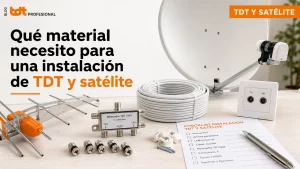 Qué material necesito para hacer una instalación de TDT y satélite
Una instalación mixta de TDT y satélite permite llevar a la misma vivienda la señal de televisión terrestre y la señal procedente de una parabólica. Es una solución habitual cuando quieres ver canales TDT de forma [...]
-
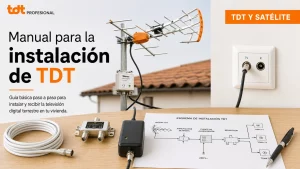 Manual para la instalación de TDT
Instalar TDT no consiste solo en colocar una antena en el tejado y bajar un cable hasta la televisión. Para que la señal llegue con estabilidad a una o varias tomas, la instalación debe estar bien [...]
-
 Cómo instalar un LNB Monoblock paso a paso y cuándo conviene usarlo
Un LNB Monoblock es una solución muy práctica cuando quieres recibir dos satélites cercanos con una sola parabólica y sin complicar demasiado la instalación. El caso más habitual es la recepción conjunta de Astra 19,2ºE y [...]
-
 Instalación de un amplificador de mástil: material, conexión y comprobación
La instalación de un amplificador de mástil puede mejorar una red TDT cuando la señal captada por la antena es correcta pero pierde nivel antes de llegar a la vivienda. Su ventaja es que se coloca [...]
-
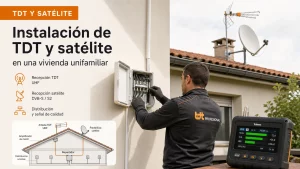 Instalación de TDT y satélite en una vivienda unifamiliar: caso práctico paso a paso
Cuando se habla de instalar TDT y satélite en una vivienda, muchas veces se explican esquemas generales que sirven como orientación, pero no siempre ayudan a visualizar cómo se resuelve una instalación real. En la práctica, [...]
-
 Mezclador de TDT y satélite: tipos, usos y montaje correcto
Un mezclador de TDT y satélite permite combinar la señal terrestre y la señal satélite para transportarlas por un mismo cable coaxial. Es una solución muy útil cuando una vivienda o instalación quiere recibir TDT y [...]
-
 Amplificador interior de vivienda o fuente de alimentación: diferencias y cuándo usar cada uno
Un amplificador interior de vivienda y una fuente de alimentación para antena pueden parecer equipos parecidos porque ambos se instalan dentro de casa y se conectan al cable coaxial. Sin embargo, cumplen funciones diferentes. Confundirlos es [...]
-
 Cable coaxial para tiradas largas: pérdidas, calidad y errores de instalación
El cable coaxial es uno de los elementos más discretos de una instalación de televisión, pero puede decidir si la señal llega estable o si aparecen cortes, pixelación y pérdidas en algunas tomas. En tiradas largas [...]
Data Network, WiFi, Fibre Optics, Voice Telephony, Racks and Accessories
At TDTprofesional we are Telecommunications specialists. We have a pre-sales and after-sales customer service team of engineers and technicians in the sector.
Find all the material for ICT telecommunications installations.
Select the category you want to access: Network and WiFi Equipment, Fibre Optic Installation Equipment, Voice and Telephony Systems, Rack and Wall Cabinets.
Wi-Fi Zone
In the Wi-Fi Zone we can find all the material necessary to achieve a stable and good quality internet connection.
From complex installations that seek to improve coverage, to the simplest and most common devices that provide WiFi at home.
We have a wide range of Routers, Switches, WiFi Repeaters and WiFi Antennas. These devices are very common and are used for domestic use as well as in shops, hotels, companies or complexes. We also have equipment such as Access Points, PLC, 4G Antennas or CPE Radio Links, to improve the WiFi signal according to the limitations and needs of each situation and location. These require a more elaborate installation.
PoE injectors; for power supply by data cable and UPS; to protect your equipment against power cuts or power surges.
CoaxData Cable Internet, to distribute internet signal through TV distribution.
Fibre Optic Zone
The use of fibre optics is becoming more and more common in any telecommunications infrastructure. Most shops, buildings and offices already have it installed and in homes it is becoming more and more common. The LAN backbone has also become a fibre-based communication system.
We have elements for fibre optic distribution, for reducing the optical power of the fibre, increasing the number of available optical outputs, for adapting and connecting different devices to fibre optics and for providing fibre to the end user. In addition to the most frequent components, located in this category, such as Optical Emitters and Receivers, Optical Fibre Attenuators, Optical Splitters, Optical Fibre Converters and GPON (ONT and OLT), we have other related categories.
- Professional Tools: we highlight the Fiber Optic Fusion Splicer valid for Type F installer certification.
Thanks to the fusion splicer, fibre splices are made by core fusion, thus achieving precise and durable splices. - Storage and Accessories: We have Fibre Boxes to collect and protect the distribution, and F.O. Accessories such as splices, protectors, cleaners and alcohol.
Basic Telephony
Basic telephony refers to the standard telephone communication service that allows the connection of fixed lines. Despite the growing popularity of internet and fibre optics, basic telephony is still an important option in most telecommunications installations (ICT).
In any telephone network, the user's indoor network employs Telephone Access Points (PAU) to receive the pair and distribute the cable throughout the home. Mobile coverage repeaters are also often used to amplify the outdoor signal and transmit it to the indoor antenna. We have different tools and specific strips to facilitate the installation.
Rack cabinets
Rack cabinets organise and protect the server and the rest of the company's IT and communications components.
It is common for companies to install the hardware in a special rack room, where access is restricted to authorised personnel only.
Rack cabinets are used to house, cool and maintain electronic, computer and communications equipment. They are used for structured and coaxial cabling as well as voice cables. They are organised according to size: 10‘ Mini Wall Racks, 19’ Wall Racks, 19’ Floor Racks, Panels, Trays, Power Strips and Accessories.